
Men's vein & fertility care · Los Angeles
Varicocele evaluation & treatment starts with the reason it matters to you.
Enlarged scrotal veins may cause a dull ache, visible swelling, testicular asymmetry, or fertility concerns—but many varicoceles cause no problem at all. EVSLA connects the physical examination, ultrasound when appropriate, symptoms, semen testing, and personal goals before discussing observation, surgery, or image-guided embolization.
- Urologic evaluation first
- Fertility goals considered
- Nonsurgical option discussed
A vein pattern worth checking
Does the ache build while you stand?
- Dull scrotal heaviness worsens later in the day
- Enlarged veins become easier to see or feel
- Fertility testing shows abnormal semen parameters
What is a varicocele?
A varicocele is an abnormal enlargement of veins in the scrotum, usually involving the pampiniform plexus that drains blood from the testicle. Blood may pool or flow backward when the vein pathway and valves do not move it efficiently.
Most varicoceles are on the left and many cause no symptoms. A clinically important varicocele may be associated with a dull ache, heaviness, swelling, testicular size changes, or abnormal semen parameters. A clinician should confirm that the varicocele—not another scrotal condition—is the likely source of the problem.
Clinical references: Mayo Clinic, Urology Care Foundation, AUA/ASRM Male Infertility Guideline
Varicocele symptoms
Some are silent; others create a repeatable pattern
The pattern matters as much as the presence of a vein. Note whether discomfort changes with standing, exertion, time of day, or lying down.
When not to wait
Sudden severe testicle pain is an emergency
Varicocele discomfort is usually dull and gradual. Sudden, intense pain—especially with swelling, nausea, vomiting, or a testicle sitting higher than usual—can indicate testicular torsion, which needs emergency evaluation.
Get help now: Go to an emergency department for sudden or severe testicle pain. Prompt evaluation also matters for rapidly increasing swelling, fever, skin redness, injury, a new firm lump, or pain that does not follow the expected varicocele pattern.
Urgent-care reference: Mayo Clinic: Testicular Torsion, , .
Why the veins enlarge
Blood pools when the return pathway loses efficiency
The pampiniform plexus is a network of veins around the testicular artery. It helps drain the testicle and regulate temperature. Anatomy makes the left side more prone to increased venous pressure and backward flow.
The left testicular vein joins the left renal vein at a right angle, creating a longer, less direct return route.
Dilated veins may become visible, palpable, or uncomfortable—especially while upright.
In some patients, the altered environment is associated with testicular growth or semen abnormalities.
Clinical reference: Mayo Clinic.
Varicocele and fertility
An association is not the same as a diagnosis
Varicoceles are common, and most men who have one do not have infertility. When conception is delayed, both partners need a timely evaluation; the varicocele is one possible contributor among many.
Clinical nuance: Current AUA/ASRM guidance supports considering surgical repair for men attempting conception who have a palpable varicocele, infertility, and abnormal semen parameters. It advises against repair of a nonpalpable varicocele detected only on imaging.
01
Start with semen testing
One or more semen analyses help establish whether sperm concentration, movement, or shape is abnormal.
- Concentration
- Motility
- Morphology
- Repeat when appropriate
02
Assess the whole couple
Age, ovarian reserve, time trying to conceive, and other female and male factors can change the best timeline.
- Both partners evaluated
- Time trying to conceive
- Age and ovarian reserve
- Other male factors
03
Set realistic endpoints
Treatment may improve semen parameters in selected patients, but it cannot guarantee pregnancy or replace every fertility therapy.
- No pregnancy guarantee
- Goal-based treatment
- Compare all options
- Shared decision
04
Plan follow-up in months
Sperm production takes time, so repeat semen testing is usually not an immediate measure of success.
- Allow biologic time
- Repeat semen analysis
- Coordinate fertility care
- Measure the stated goal
How varicocele is diagnosed
Confirm the vein, then confirm why it matters
A diagnosis begins with history and examination—usually while standing and sometimes during a Valsalva maneuver. Ultrasound is useful when the examination is uncertain, the anatomy needs clarification, or another cause must be excluded.
Varicocele diagnostic pathway
Diagnostic references: Mayo Clinic. Urology Care Foundation guidance should also be reviewed.
Varicocele treatment options
Treat the impact—not the ultrasound alone
Observation is appropriate for many patients. When a varicocele is clinically important, compare the expected benefit, uncertainty, recovery, and risks of each path.
Path 1
Observe and support
For no symptoms, mild discomfort, or no evidence of testicular harm.
- Periodic examination when appropriate
- Supportive underwear
- Activity and pain-management guidance
- Repeat testing only when clinically useful
Path 2
Microsurgical repair
A urologist ligates abnormal veins while preserving the artery, lymphatics, and other structures.
- Common definitive repair approach
- Small groin or subinguinal incision
- General anesthesia is typical
- Hydrocele, recurrence, infection, or artery injury are possible
Path 3
Varicocele embolization
An interventional radiologist closes abnormal testicular veins from inside the venous system.
- No scrotal incision
- Local anesthetic and sedation often used
- Image-guided coil, plug, or liquid embolic placement
- Technical failure, recurrence, contrast, or migration risks require discussion
Nonsurgical varicocele treatment
Redirect blood flow through a tiny vein access
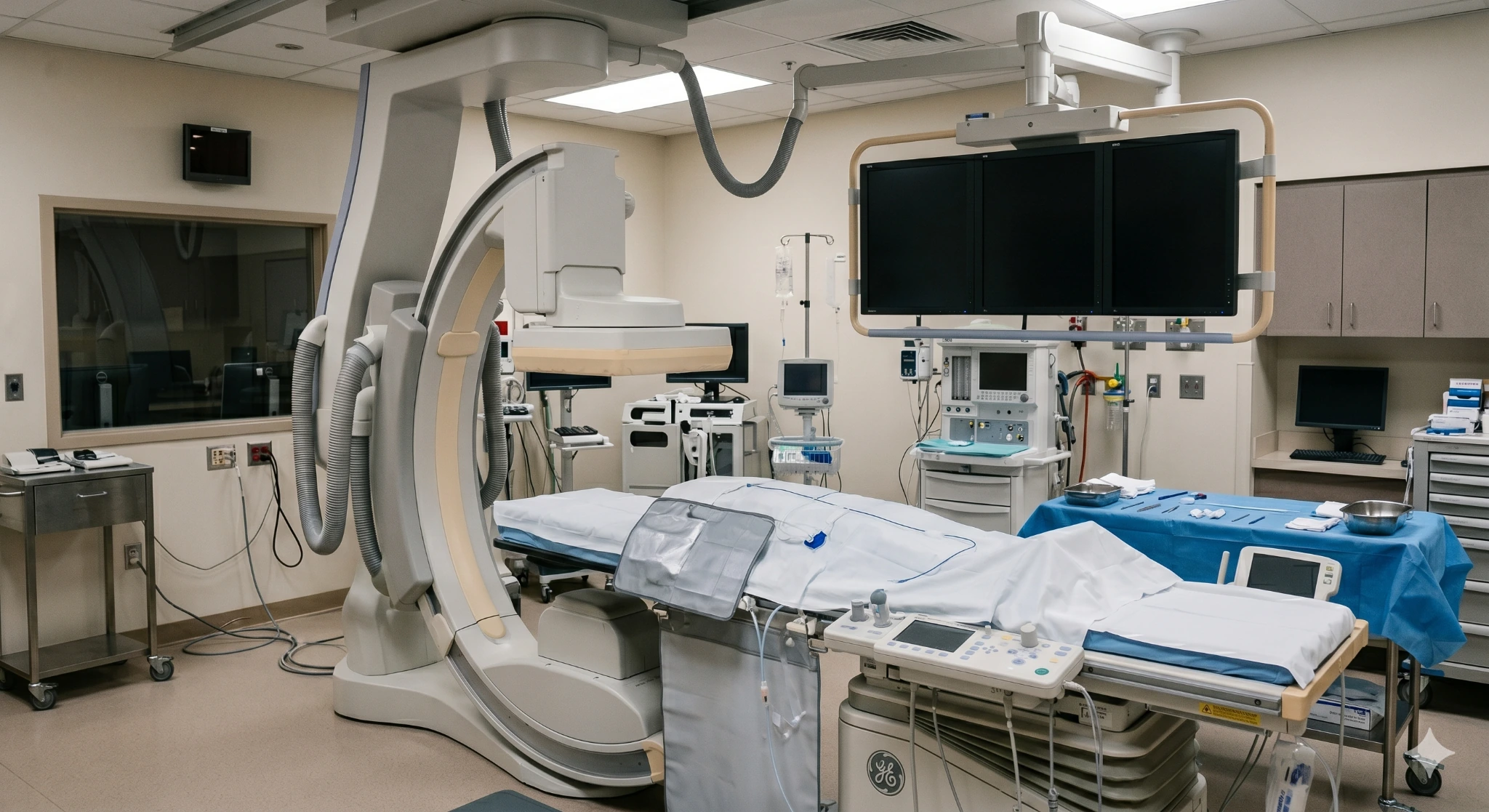
Varicocele embolization uses live X-ray imaging and a catheter to map the abnormal drainage pathway, close selected veins, and redirect blood into healthier routes.
- Image-guided catheter procedure
- Often performed outpatient
- No scrotal incision
- Venography maps reflux
- Embolic method is anatomy-based
- Follow-up matches the treatment goal
Confirm candidacy
Review examination, symptoms, ultrasound, prior repair, semen testing, fertility goals, and reasons that another treatment may fit better.
Map the veins
A catheter is advanced from a neck or groin vein. Contrast venography shows the gonadal vein, reflux, branches, and collateral pathways.
Close abnormal routes
Coils, plugs, sclerosant, or a combination may be used to stop backward flow while preserving normal venous drainage.
Measure the outcome
Follow pain, swelling, examination findings, and semen parameters when fertility improvement was a treatment goal.
Procedure references: RadiologyInfo.org.
Who may be a candidate?
The vein must match the clinical problem
Treatment may be reasonable when the varicocele is clinically confirmed and linked to persistent characteristic pain, testicular effects, or selected infertility findings. Embolization candidacy also depends on venous anatomy and prior repair.
Questions that shape the decision
- Is the varicocele palpable and consistent with the examination and ultrasound?
- Has another cause of scrotal pain, swelling, or infertility been evaluated?
- Are symptoms persistent despite reasonable supportive care?
- Are semen parameters abnormal, and how do both partners' fertility factors affect timing?
- Is this a recurrent varicocele after prior surgery or embolization?
- Do the venous access route and anatomy make embolization technically reasonable?
What the consultation should accomplish
A recommendation with a clear reason and endpoint
The visit should end with a defined goal—pain relief, protection of testicular function, fertility planning, or observation—and a realistic way to measure progress.
- Confirm the indication Connect the varicocele to the problem instead of treating an incidental scan finding.
- Compare options Discuss observation, urologic surgery, and embolization with balanced benefits, risks, recovery, and evidence.
- Coordinate fertility care When conception is the goal, align treatment timing with semen testing and the partner's reproductive evaluation.
- Review the vein anatomy Confirm the gonadal-vein route, reflux, branches, collaterals, and any reason embolization may not be feasible.
- Define the outcome Choose pain, examination findings, testicular function, or semen parameters as the relevant treatment endpoint.
- Set the follow-up plan Define which symptoms, examination findings, ultrasound, or semen results will be reassessed and when.
After varicocele embolization
The access site heals first; the treatment goal is measured over time
Recovery instructions vary by access route, embolic technique, medicines, job, exercise, and fertility plan. Follow the treating team’s instructions rather than a generic timeline.
Procedure day
Observation and discharge
The team monitors the access site, pain, nausea, urination, walking, and sedation recovery before same-day discharge when appropriate.
First days
Mild soreness may occur
Access-site bruising, pelvic or back discomfort, and temporary scrotal aching or inflammation can occur. Use the prescribed plan and call for concerning changes.
Early weeks
Return gradually
Desk work and light activity may resume quickly for many patients, while lifting, exercise, and sexual activity require individualized clearance.
Follow-up
Measure the right result
Recheck pain and veins; repeat semen analysis over the appropriate interval when fertility was part of the indication.
Care team
Who evaluates varicocele embolization at EVSLA
This concept positions EVSLA’s physicians around venous imaging review, embolization candidacy, image-guided treatment, and follow-up in coordination with urology and fertility specialists. Physician credentials, referral workflow, exact services, and location availability must be confirmed before publication.

Harout Dermendjian, MD
Endovascular Specialist
Featured in this concept for venous imaging review, embolization planning, and minimally invasive care. Confirm approved credentials and scope before publication.

Kartik Kansagra, MD
Endovascular Specialist
Featured in this concept for varicocele assessment and image-guided treatment discussion. Confirm approved credentials and scope before publication.

Sipan Mathevosian, MD
Endovascular Specialist
Featured in the EVSLA master brief as the embolization-silo lead. Confirm approved credential wording, role, and location availability before publication.
Local access
Three clinics across Los Angeles County
Confirm at which locations varicocele consultations, imaging review, embolization, and follow-up are performed. Services may differ by location.
Glendale
445 W Broadway
Glendale, CA 91204
Simi Valley
2750 Sycamore Dr, Ste 200
Simi Valley, CA 93065
La Cañada Flintridge
1407 Foothill Blvd
La Cañada, CA 91011
Questions patients ask
Varicocele, answered plainly
What is a varicocele?
A varicocele is an enlargement of veins in the scrotum, usually in the pampiniform plexus around the testicle. It is similar in concept to a varicose vein: blood pools or flows backward because the drainage pathway is inefficient.
Most occur on the left because of normal differences in venous anatomy.
What are the symptoms of a varicocele?
Many varicoceles cause no symptoms. Others cause a dull ache, dragging sensation, heaviness, swelling, or enlarged veins that become more noticeable with standing, activity, or later in the day and improve when lying down.
Some patients are evaluated because of testicular-size differences or fertility findings rather than pain.
Does a varicocele always cause infertility?
No. Most men with a varicocele do not have fertility problems. A varicocele may contribute to abnormal sperm production or quality in some men, but fertility depends on many male and female factors.
A semen analysis and complete fertility evaluation are more informative than the vein’s appearance alone.
Can fertility improve after varicocele treatment?
Selected infertile men with a palpable varicocele and abnormal semen parameters may see improvement after repair, and current guidelines support considering surgical varicocelectomy in that setting.
Improvement is not guaranteed, takes time to assess, and does not ensure natural conception. Both partners’ fertility evaluation and timeline should guide the decision.
When is testicle pain an emergency?
Seek emergency care for sudden or severe testicle pain, particularly with swelling, nausea, vomiting, abdominal pain, or a testicle sitting higher than usual. These features can indicate testicular torsion, which requires prompt treatment.
A new lump, fever, rapidly increasing swelling, or persistent pain also needs medical evaluation.
How is a varicocele diagnosed?
A clinician usually examines the scrotum while you are standing and lying down and may ask you to bear down in a Valsalva maneuver. The examination assesses both testicles, tenderness, vein size, and whether the veins reduce.
Doppler ultrasound may confirm reflux, measure the veins and testicles, or look for another cause when the examination is uncertain.
What do varicocele grades mean?
Clinical grades describe what a clinician can feel or see. A small varicocele may be felt only with a Valsalva maneuver; a larger one may be felt without straining or visibly apparent.
Grade alone does not decide treatment. Symptoms, testicular function, semen findings, fertility goals, age, and other diagnoses matter.
Does every varicocele need treatment?
No. A varicocele that causes no symptoms and shows no evidence of testicular harm may be observed. Supportive underwear and appropriate pain medicine may help mild discomfort.
Treatment is considered when the clinical varicocele is linked to persistent characteristic pain, testicular growth or function concerns, or selected infertility findings.
What is varicocele embolization?
Varicocele embolization is an image-guided procedure performed through a small vein access, usually in the neck or groin. A catheter maps the abnormal testicular-vein pathway, and coils, plugs, sclerosant, or another embolic method closes selected veins.
Blood then returns through healthier venous pathways without a scrotal incision.
Is embolization better than varicocele surgery?
Neither approach is best for every patient. Embolization avoids a scrotal or groin incision and may offer a quicker return to light activity. Microsurgical repair has extensive urologic experience and may offer the best fit for some anatomy or fertility situations.
Compare technical success, recurrence, hydrocele, artery injury, radiation and contrast exposure, anesthesia, prior repair, recovery, and local expertise.
What are the risks and recovery after embolization?
Possible risks include access-site bleeding or bruising, infection, contrast reaction, vein injury, inflammation, back or scrotal pain, unintended embolization or device migration, technical failure, and recurrence. Serious complications are uncommon but must be discussed individually.
Many procedures are outpatient. Return to work, exercise, lifting, and sexual activity depends on the access site, technique, symptoms, and treating team’s instructions.
Can a varicocele return, and does a right-sided varicocele need a scan?
A varicocele can persist or recur after either surgery or embolization, sometimes requiring repeat treatment. Follow-up should be based on the original goal—pain, examination, testicular function, or fertility.
Current AUA guidance does not recommend routine abdominal imaging solely for an isolated small or moderate right varicocele. Clinical judgment may support imaging for a new, large, or non-reducible varicocele.
A varicocele deserves a goal-based treatment decision.
Bring urology or fertility notes, scrotal-ultrasound images, semen analyses, hormone results, and records of prior varicocele repair. EVSLA can review whether image-guided embolization is an appropriate option to discuss alongside observation and urologic surgery.
For sudden or severe testicle pain—especially with nausea, swelling, or a high-riding testicle—seek emergency care now.